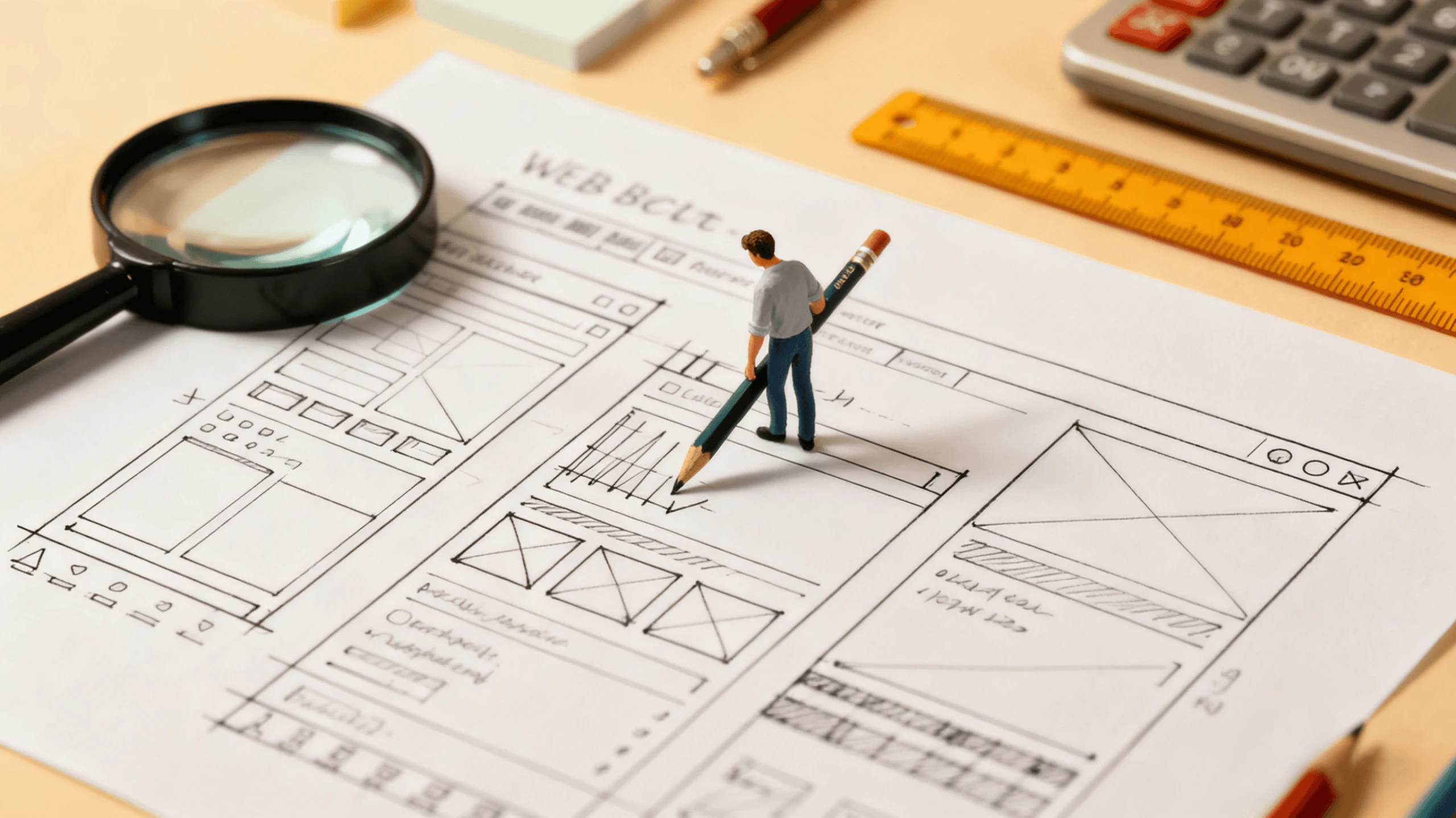
In the digital age, a corporate website is no longer merely an “information board.” It is the first point of contact between a brand and its users, a core conversion channel, and a long-term vehicle for trust. Website interface design determines whether that vehicle can create value. A rough, confusing interface can make users leave within three seconds, while a professional and seamless experience can significantly improve retention. This article explains the irreplaceable importance of website interface design from the perspectives of user experience, brand image, and commercial conversion.
1. First Impressions Decide Everything: Interface Design Is the Company’s Digital Storefront
Psychological research indicates that users form a first impression of a website in as little as 0.05 seconds, and interface design determines that impression. Color harmony, layout clarity, and visual professionalism all influence how users judge the brand immediately.
-
Negative Example: A website with harsh colors, chaotic typography, and confusing button placement can make users assume that the company is unprofessional or that its products may be unreliable. They may close the page before the quality of the offering can be communicated.
-
Positive Example: A premium consulting company’s website uses a minimalist black-and-white palette, generous whitespace, large bold typography for core services, and subtle transitional animation. Visitors immediately perceive the brand as professional and dependable, and time on site is 50% higher than the industry average.
For a business, website interface design is the online equivalent of storefront design. Physical stores invest in window displays and spatial planning; corporate websites must likewise establish positive perception from the moment the page opens.
2. Improve User Experience: Reduce Decision Effort and Increase Retention
Users visit a website to solve a need—learning about a product, requesting a service, or making a purchase. The purpose of interface design is to help users complete their objective with the least possible effort.
-
Clear Information Hierarchy Reduces Cognitive Effort
Professional interface design arranges content according to user priorities. Core services or products appear prominently in the first screen, while secondary information such as company background and contact details appears later. H1-H6 headings, font size, and color contrast establish a clear hierarchy.
Unlike template websites that pile information together, a customized interface allows users to identify what they need immediately and prevents loss caused by hidden or confusing entry points.
-
Smooth Interaction Logic Improves the Experience
Button placement, form simplicity, page transitions, and loading performance are all fundamental aspects of interface design.
For example, an e-commerce site can use a high-saturation color for a fixed “Buy Now” button on the product page. A design studio can allow portfolio images to expand on click and switch through swipe gestures. Such details improve satisfaction and increase time on site.
-
Adaptation Across Devices Reaches More Users
By 2026, mobile users account for more than 70% of online traffic. High-quality interface design therefore includes responsive optimization: layouts adjust automatically on phones to prevent tiny text or displaced buttons, while tablets and foldable screens retain consistent visual and functional experiences.
Without responsive adaptation, websites may display broken layouts or unusable controls on mobile devices and lose a large proportion of prospective users.
3. Strengthen Brand Recognition: Stand Out in a Homogeneous Market
In markets where products are increasingly similar, brand differentiation becomes a company’s central competitive advantage, and website interface design is an important medium for communicating brand personality.
-
Integrate the Brand’s Visual Identity System Deeply
Professional interface design incorporates the brand’s colors, logo, typography, and visual elements—including icons and illustration styles—throughout every page:
-
Technology companies often use blue or dark backgrounds with minimalist geometric icons to communicate innovation and rationality.
-
Creative design studios can use distinctive palettes—such as the yellow-green discussed elsewhere—and hand-drawn icons to emphasize creativity and individuality.
-
Maternal and baby brands often use soft pastel palettes, rounded typefaces, and friendly illustrations to communicate safety and warmth.
This visual consistency creates strong brand memory. Users may associate a red-and-white palette and minimalist layout immediately with a particular premium appliance brand.
-
-
Create Distinctive Visual Memory Cues
Unlike repetitive template websites, custom interface design can include visual elements unique to the brand. A coffee brand might use coffee-bean textures as a subtle background pattern, while an outdoor brand might use dynamic natural scenery on the first screen. These details leave users with a memorable impression of difference.
4. Improve Commercial Conversion: Turn Traffic Into Retained Opportunity
The ultimate purpose of a corporate website is to generate commercial conversion—whether through inquiries, purchases, or lead submissions—and interface design is a major determinant of conversion efficiency.
-
Guide User Behavior and Lower Conversion Barriers
Visual guidance within the interface can encourage conversion naturally:
-
Use arrows, color blocks, and motion to direct attention toward buttons such as “Contact Us Now” or “Start a Free Trial.”
-
Simplify forms and remove unnecessary fields—for example, reduce ten required entries to three essential ones.
-
At moments of hesitation, such as checkout, add trust modules including customer reviews and after-sales guarantees to reduce concern.
Data indicates that an optimized conversion path can increase conversion rates by 30% to 50%.
-
-
Improve SEO Performance and Acquire Organic Traffic
Interface design affects not only users, but also a website’s SEO performance:
-
Semantic HTML, appropriate heading structure, and optimized image alt attributes help search engines crawl and understand the website.
-
Clear internal linking—for example, Product Details → Related Case Studies → Customer Reviews—strengthens internal authority.
-
Lightweight visual design, including WebP images and restrained animation, improves loading speed, which is a core search-ranking factor.
An SEO-friendly interface can help a company gain more organic traffic and reduce customer-acquisition costs.
-
5. Increase User Trust: Build a Foundation for Long-Term Relationships
In a virtual environment, users often form trust through small details, and the professionalism of the interface concentrates those details into a coherent experience.
-
A carefully typeset website with accurate content and smooth interaction makes users feel that the company works rigorously and can be trusted.
-
Conversely, a site filled with typographical errors, blurred images, and broken buttons can make users question the company’s competence or even suspect fraud.
The arrangement of trust modules—such as certifications, client case studies, and team introductions—also influences credibility. Presenting them prominently in clear card-based layouts is more persuasive than placing them in a disorganized collection.
6. Support Long-Term Business Growth: Enable Iteration and Expansion
High-quality interface design is not a one-time deliverable. It is built on a modular architecture that can adapt flexibly as the business evolves.
-
When a company introduces a new product line, new content modules can be added within the existing framework without breaking visual consistency.
-
When the business expands internationally, multilingual versions can be introduced quickly and the interfaces for payment, logistics, and other functions can be adapted.
-
When new tools such as AI customer service or live-streaming systems are required, modular interface design can integrate them without rebuilding the entire website.
Template websites, by contrast, often have fixed layouts and functions that cannot support expansion and eventually become obstacles to growth.
Conclusion: Website Interface Design Is a Strategic Investment
For a business, website interface design is not optional visual decoration. It is a core strategic investment that determines retention, brand trust, and commercial conversion. It improves user experience, strengthens recognition, and can generate long-term gains in both traffic and conversion.
As competition becomes more homogeneous, excellent website interface design becomes a company’s core capability in the digital age—helping users remember, trust, and choose the brand.
FAQ
-
How is website interface design related to user experience?
Interface design is a core component of user experience. Good interface design reduces operational effort and increases satisfaction, while poor design causes users to leave.
-
Do small and medium-sized companies need to prioritize website interface design?
Yes. Smaller companies often need high-quality interface design even more, because it helps differentiate the brand, build trust, and compete more effectively.
-
Is website interface design expensive?
Cost depends on the complexity of the requirements. Small and medium-sized companies can choose a lightweight customization approach focused on essential functionality and visual design to maximize results at a reasonable cost.