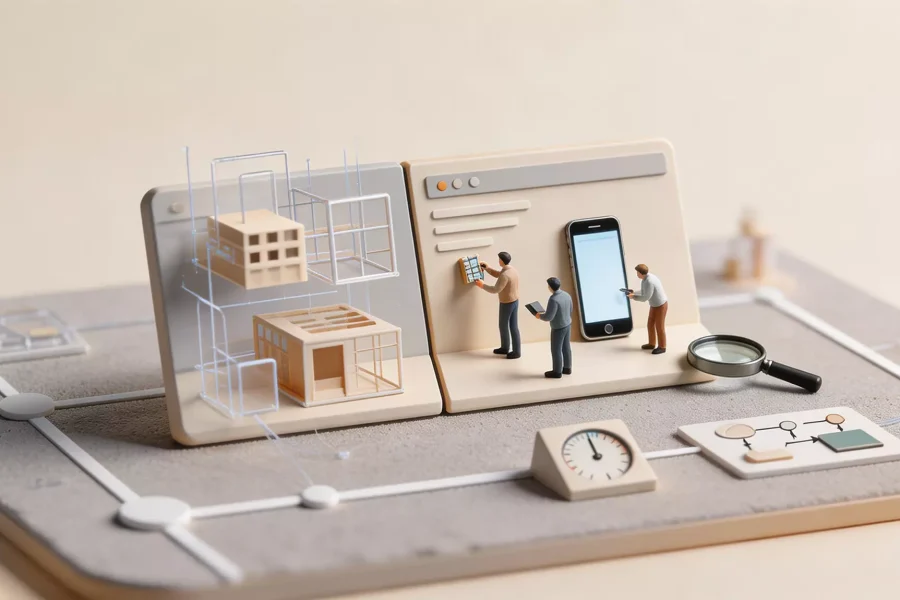
Why Design Processes Require More Thought After AI Enters the Workflow
Over the past several years, AI has entered the design industry in an almost irreversible way. Whether the task involves interface sketches, copy generation, organizing user research, prototype exploration, or visual proposals, more designers are making AI part of their everyday toolset. A new problem has followed: tools are multiplying, but processes are not necessarily becoming clearer. While pursuing new capabilities, many teams focus on “what can be done” instead of “why it should be done.”
Design is fundamentally not a competition in speed. It is a process of making judgments around problems, objectives, and user experience. AI can help us produce more quickly, but it cannot replace a designer’s understanding of direction. When a design process loses judgment and retains only mechanized output, greater efficiency may simply amplify errors more quickly. The important question is not whether AI can complete a particular step, but whether it makes design decisions more accurate, communication smoother, and collaboration easier.
Many design teams pass through a similar sequence after encountering AI: excitement, confusion, and finally fatigue. Excitement comes from rapid content generation. Confusion begins when everyone experiments in different ways. Fatigue follows when large volumes of output all look “roughly the same” but cannot be converted directly into business value. At this point, reconsidering the design process becomes essential. AI is not here to replace the process. It is more like a current of water that can pass through rigid steps and wash away everything except what truly matters.
Intent Matters More Than Activity
One of the most common problems in design work is “doing a great deal without understanding why.” Once AI lowers the threshold for action, this problem becomes even more pronounced. A designer previously needed substantial time to organize materials, draw sketches, and revise copy repeatedly. These tasks can now be completed rapidly. But without a clear objective at the beginning, AI only helps you reach an uncertain destination more quickly.
A design process should therefore begin with intent. Intent is not a vague slogan; it is a clear definition of the problem boundary. Are you optimizing registration conversion or improving the first-use experience? Are you increasing information readability or building brand trust? Different intentions directly influence how AI should be used and how you determine whether the result is effective.
From this perspective, AI is better suited to helping designers explore solutions than deciding which solution to choose. It can open more possibilities, but people must still filter, judge, and converge. An excellent design process does not automate every step. It reserves the work that most deserves human thought for people and gives repetitive, low-value labor to tools.
The Greatest Threat to a Design Process Is Not Slowness, but the Absence of a Clear Through-Line
When some teams discuss efficiency, their first reaction is to reduce meetings, shorten delivery cycles, and increase output. Yet project quality is often affected less by speed than by whether the work has a clear through-line. A process without one resembles a table covered with tools when nobody knows which to pick up first. The more AI tools a team adopts, the more easily this situation occurs.
A healthy design process should include at least several essential stages: problem definition, information gathering, solution exploration, evaluation and validation, and implementation collaboration. AI can participate in many of them, but every stage needs a defined output. During problem definition, for example, AI can help summarize interview notes. During solution exploration, it can generate different directions rapidly. During evaluation, it can help organize feedback and identify patterns. Without a shared design objective, however, these outputs remain a collection of attractive but disconnected materials.
The value of a process does not come from complexity. It comes from repeatability, traceability, and the ability to support judgment. Designers should not ask only, “Can AI do this for me?” They should also ask, “After AI does this, which part of the process becomes clearer?” That is the outcome process optimization should genuinely pursue.
Designers in the AI Era Work Like Water
“Being like water” does not mean abandoning structure. It means preserving fluidity within structure. Water has no fixed shape, yet adapts to different containers. It does not advance through brute force, yet continually penetrates barriers. In a design context, this means maintaining flexibility amid uncertainty, preserving judgment through change, and finding the shortest path through large amounts of information.
This ability is especially important in the AI era. AI continually generates new content, suggestions, and possibilities. Without strong filtering ability, designers are easily led by the results. A truly efficient designer is not always generating. They know when to stop, when to converge, and when to investigate more deeply.
Working like water also means not becoming attached to one workflow template. Many people collect complete libraries of prompts, methods, and automation scripts, only to discover that they do not fit the current project. A design process is not better because it contains more methods. It is better when it fits the problem more closely. AI should enter the workflow differently depending on the team, product, and project stage.
If your team is in an early exploration stage, AI can support rapid divergence and help establish initial understanding. If the project has entered execution, AI is better suited to organizing standards, filling in details, and improving delivery efficiency. During a retrospective, it can help summarize experience, identify patterns, and turn lessons into retained knowledge. A process gains meaning only when tools are placed inside real scenarios.
How to Integrate AI into the Design Process Properly
To make AI part of the design process, the priority is not stacking features, but designing how it will be used. Many teams initially treat AI as a “universal assistant” and expect it to complete a large number of tasks. Practice soon reveals that the more complex the work, the more clearly responsibilities must be divided.
A more reasonable approach is to place AI where it fits. Tasks well suited to AI generally share three characteristics: the input information is relatively clear, multiple versions are acceptable, and human judgment remains important. Organizing research notes, generating competitor-comparison frameworks, expanding copy directions, and suggesting component names are all appropriate uses. Questions involving brand judgment, user emotion, and experience priorities cannot simply be handed to a model.
In real projects, consider the following working methods:
-
Have the designer define the problem first, then ask AI to expand possible solutions rather than allowing it to operate without direction.
-
Treat AI-generated content as a first draft or an alternative, not the final answer.
-
Use AI for highly repetitive, low-differentiation tasks and reserve time for more critical design judgments.
-
Evaluate AI output together with real user feedback, business metrics, and team consensus rather than judging it only by whether it “looks good.”
The central principle is that AI is not the center of the workflow. It is an accelerator within the workflow. It can improve efficiency at particular stages, but cannot replace the logic of the entire design system.
Why So Many AI Design Experiments Eventually Disappear
Many teams have experienced the same pattern: enthusiasm is high at the beginning, everyone tries different AI tools, numerous concepts are generated, and even minor tasks are assigned to AI. Several weeks or months later, however, only a few tools remain in continued use and the process has not changed substantially. The problem is not that AI lacks value. It is that AI was never embedded in the real rhythm of work.
Many failed attempts share one characteristic: they focus on “production efficiency” while ignoring “collaboration efficiency” and “decision efficiency.” Design work includes far more than delivering a visual result. It also requires repeated communication with product, development, operations, and business stakeholders. If AI helps generate early-stage content but does not improve expression, alignment, and project progress, its value is significantly reduced.
Another common problem is the absence of shared standards. Team members use different prompts, tools, and evaluation methods, producing results that are difficult to reuse and impossible to accumulate into shared knowledge. A mature approach does not require every person to possess a completely different set of AI techniques. It gradually establishes shared internal principles: which tasks AI can handle, which require human judgment, which outputs need review, and which conclusions can become formal standards.
Once these standards exist, AI becomes more than a “personal efficiency tool.” It becomes part of the team’s productive capacity.
The Ability Designers Most Need to Develop Is Judgment
Many people worry that AI will replace designers. In real work, however, the capability most difficult to replace has never been “drawing.” It is determining what deserves to be drawn, why it should be drawn that way, and what effect it will produce. AI can generate form rapidly, but it cannot assume responsibility for the result.
This is why designers in the AI era should strengthen three abilities. The first is problem decomposition: converting vague requirements into clear tasks. The second is selection: identifying strengths and weaknesses quickly among large numbers of results. The third is communication: explaining design decisions clearly so the team understands and supports them. Compared with simply learning more tools, these three abilities have greater influence on a designer’s long-term value.
If AI is an amplifier, a designer’s judgment is what gets amplified. AI helps a person with strong judgment explore faster and more broadly. For someone with weak judgment, it only accelerates the production of noise. The richer the tool environment becomes, the more important design fundamentals remain. Structural awareness, a sense of objectives, information-organization skills, and user understanding do not become obsolete because AI exists; they become more important.
Return the Process to Real Problems Instead of Chasing Excitement
The design industry has always been enthusiastic about new technology, and there is nothing wrong with that. But when enthusiasm remains superficial, attention shifts toward demonstrations, concepts, and discussion rather than the complexity of real scenarios. AI is especially vulnerable to this problem. It can make work appear easier, but the real challenge has never been “Can it generate something?” It is “Does the generated result move us closer to solving the problem?”
When rebuilding a design process, the priority should therefore not be the most impressive working method, but the realities of the business, users, and team collaboration. Ask yourself: Is this step genuinely necessary? Does this tool actually reduce cost? Is this result truly easier to implement? When the answers are unclear, even the most powerful AI will struggle to produce stable benefits.
A strong design process should resemble water: directional but not rigid, bounded but adaptive, fluid without losing its core. AI’s value should be understood and applied inside such a process. It is not a shortcut that replaces thinking, but a tool that makes thinking more efficient, specific, and executable.
When designers clarify intent, control the rhythm, preserve judgment, and place AI appropriately, a process stops being a pile of steps and becomes a more mature way of working. Excellent design is not pushed along by technology. It maintains a clear sense of direction while technology changes.
If you are also reorganizing your team’s design process, begin with one simple question: Is AI helping you do things faster today, or helping you do the right things better? The answer often determines the difference in future performance.
To improve design efficiency and content communication further, explore more practical methods or visit 58UI for inspiration and resources suited to design teams.