Design thinking is a solution-based approach to solving problems. It is particularly useful for tackling complex problems that are ill-defined or unknown because it helps us understand the human needs involved, reframe problems in a human-centered way, generate a wide range of ideas during brainstorming sessions, and take a hands-on approach to prototyping and testing. Once you understand how to apply the five stages of design thinking, you are empowered to use this method to address complex challenges facing our companies, our countries, and the world.
What Are the 5 Stages of the Design Thinking Process?
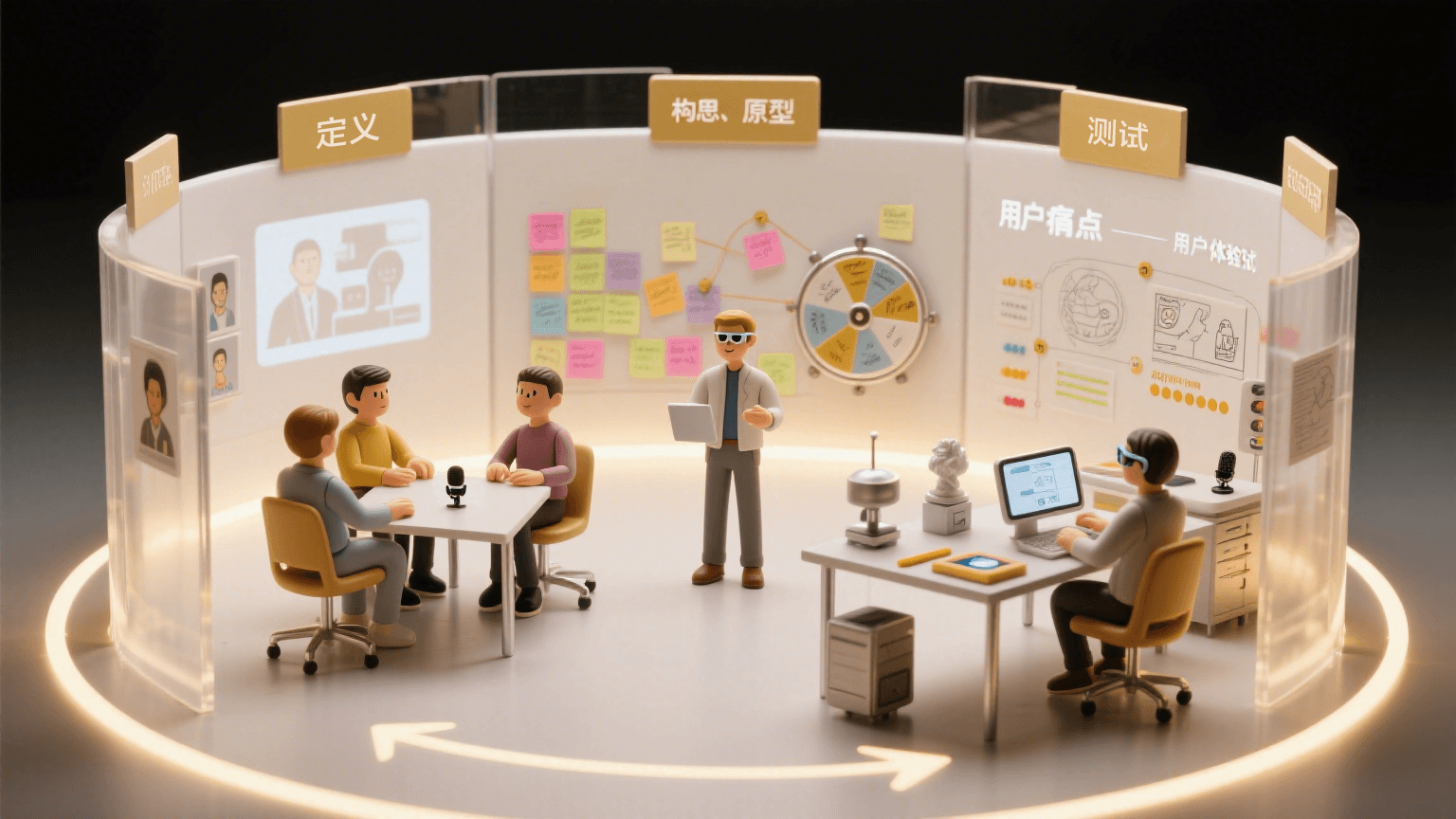
The five stages of design thinking are:
-
Empathize : Research your users’ needs.
-
Define : Identify your users’ needs and problems.
-
Ideate : Challenge assumptions and generate ideas.
-
Prototype : Start creating solutions.
-
Test : Try out your solutions.
Let us take a closer look at each stage of the design thinking process.
Stage 1: Empathize — Research Your Users’ Needs
Empathize: The first stage of design thinking, where you develop a genuine understanding of your users and their needs.
The first stage of the design thinking process focuses on user-centered research. Your goal is to develop an empathetic understanding of the problem you are trying to solve. Consult experts to learn more about the area of concern, and conduct observations to engage with and empathize with your users. You may also want to immerse yourself in the users’ physical environment to gain a deeper understanding of the problem, their experiences, and their motivations. Empathy is essential to problem-solving and the human-centered design process because it enables design thinkers to set aside their own assumptions about the world and gain genuine insight into users and their needs.
Depending on the time available, you will gather a substantial amount of information to use in the next stage. The primary purpose of the empathize stage is to learn as much as possible about your users, their needs, and the problems behind the product or service you want to create or develop.
Stage 2: Define — Identify Your Users’ Needs and Problems
Define: The second stage of design thinking, where you formulate a problem statement in a human-centered way.
During the Define stage, you will organize the information collected during the Empathize stage. You will analyze your observations to identify the core problems that you and your team have recognized so far. Both the problem and the problem statement must be defined from a human-centered perspective.
For example, you should not define the problem in terms of your own goals or your company’s needs: “We need to increase our market share of food products among teenage girls by 5%.”
Instead, you should formulate the problem statement from the perspective of the user’s needs: “Teenage girls need nutritious food to thrive, stay healthy, and grow.”
The Define stage helps the design team gather strong ideas for features, functions, and other elements that can address the problem at hand, or at least enable real users to solve the problem themselves with minimal difficulty. At this stage, you will begin moving into the third stage, Ideate, where you can ask questions that help you search for solutions. For example: “How might we encourage teenage girls to take actions that benefit them while involving our company’s food-related products or services?”
Stage 3: Ideate — Challenge Assumptions and Generate Ideas
Ideate: The third stage of design thinking, where you identify innovative solutions to the problem statement you have created.
During the third stage of the design thinking process, designers are ready to generate ideas. In the Empathize stage, you learned about your users and their needs. In the Define stage, you analyzed your observations and created a user-centered problem statement. With this solid foundation, you and your team members can begin examining the problem from different perspectives and developing innovative solutions to your problem statement.
You can use hundreds of ideation techniques, including brainstorming, brainwriting, Worst Possible Idea, and SCAMPER. Brainstorming and Worst Possible Idea are often used at the beginning of the Ideate stage to encourage free thinking and expand the problem space. This allows you to generate as many ideas as possible at the start of the process. Toward the end of this stage, you should use additional ideation techniques to investigate and test your ideas and select the strongest approaches to move forward with—either because they appear capable of solving the problem or because they contain elements that can help you work around it.
Stage 4: Prototype — Start Creating Solutions
Prototype: The fourth stage of design thinking, where you identify the best possible solutions.
The design team will now produce several inexpensive, scaled-down versions of the product, or specific features within the product, to investigate the key solutions generated during the Ideate stage. These prototypes can be shared and tested within the team, in other departments, or with a small group of people outside the design team.
This is an experimental stage. Its purpose is to identify the best solution for each problem identified during the first three stages . The solutions are implemented in prototypes and investigated one by one. Based on the users’ experiences, each solution is then accepted, improved, or rejected.
By the end of the Prototype stage, the design team will have a clearer understanding of the product’s limitations and the challenges it faces. The team will also gain greater insight into how real users behave, think, and feel when interacting with the final product.
Stage 5: Test — Try Out Your Solutions
Test: The fifth and final stage of the design thinking process, where solutions are tested to gain deeper insight into the product and its users.
Designers or evaluators rigorously test the complete product using the best solutions identified during the Prototype stage. This is the final stage of the five-stage model. However, in an iterative process such as design thinking, the results are often used to redefine one or more additional problems. This deeper level of understanding can help you investigate conditions of use and examine how people think, behave, and feel about the product. It may even lead you back to an earlier stage of the design thinking process. You can then continue with further iterations, making changes and refinements while eliminating alternative solutions. The ultimate goal is to develop the deepest possible understanding of the product and its users.
Did You Know That Design Thinking Is a Nonlinear Process?
We have outlined a straightforward and linear design thinking process in which one stage appears to lead to the next and reaches a logical conclusion through user testing. In practice, however, the process is much more flexible and nonlinear. For example, different groups within a design team may work on several stages simultaneously, or designers may collect information and create prototypes throughout every stage of a project to bring their ideas to life and visualize potential solutions as they proceed. In addition, the results of the Test stage may reveal new insights about users, leading to another brainstorming session during the Ideate stage or the development of a new prototype.
It is important to note that the five stages of design thinking are not always sequential. They do not have to follow a specific order, and they can often occur in parallel or be repeated iteratively. The stages should be understood as different modes that contribute to the overall design project rather than as a fixed sequence of steps.
The design thinking process should not be regarded as a rigid or prescriptive design method. Instead, its component stages should serve as guides for the activities you undertake. The stages can be rearranged, performed simultaneously, or repeated multiple times to gain the most informative insights about users, expand the solution space, and refine innovative solutions.
This is one of the main advantages of the five-stage model. Knowledge gained during later stages of the process can inform repeated work in earlier stages . Information is continuously used to deepen understanding of both the problem space and the solution space, and to redefine the problem itself. This creates an ongoing cycle in which designers continually gain new insights, develop new ways of viewing a product or service and its possible uses, and build a deeper understanding of real users and the problems they face.
Key Takeaways
Design thinking is an iterative, nonlinear process that focuses on collaboration between designers and users. It brings innovative solutions to life by grounding them in how real users think, feel, and behave.
This human-centered design process consists of five core stages: Empathize, Define, Ideate, Prototype, and Test.
It is important to remember that these stages are intended only as a guide. The iterative and nonlinear nature of design thinking means that you and your design team can perform several stages simultaneously, repeat them, or return to an earlier stage at any point in the design thinking process.