
Summary:User experience researchers use this observational method to identify problems and opportunities in a design.
Usability testing is a user experience research method.
During a usability test, a researcher—often called a facilitator or moderator—asks a participant to complete tasks, usually with one or more specific user interfaces. As the participant completes each task, the researcher observes their behavior and listens to their feedback.
The term “usability testing” is often used interchangeably with “user testing.”
One objection to the term “user testing” is that it can sound as though the researcher is testing the participant. We never test users; we test interfaces. The intended meaning, however, is testing with users, which is precisely the purpose of empirical research.
Why Conduct Usability Testing?
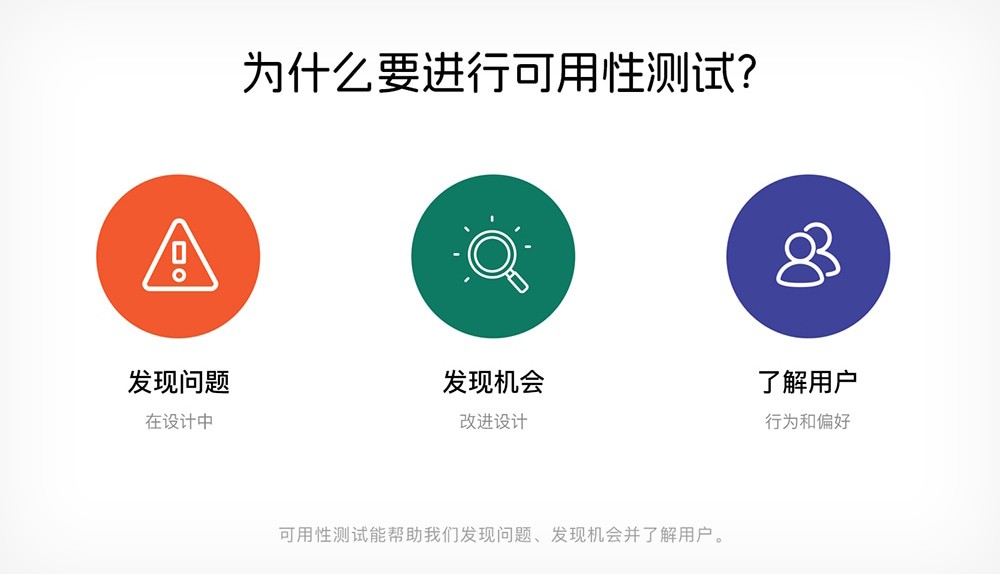
The objectives of usability testing vary by study, but they commonly include:
· Identifying problems in the design of a product or service
· Discovering opportunities for improvement
· Understanding the behavior and preferences of target users
Why is usability testing necessary? Shouldn’t an excellent professional UX designer already know how to create a strong user interface? Even the best UX designer cannot create a perfect—or even sufficiently good—experience without observing real users and iterating according to how they interact with the design.
There are many variables involved in designing an appropriate interface, and even more variables in the human mind. The number of possible combinations is enormous. The only reliable way to get the UX right is to test it.
Elements of Usability Testing
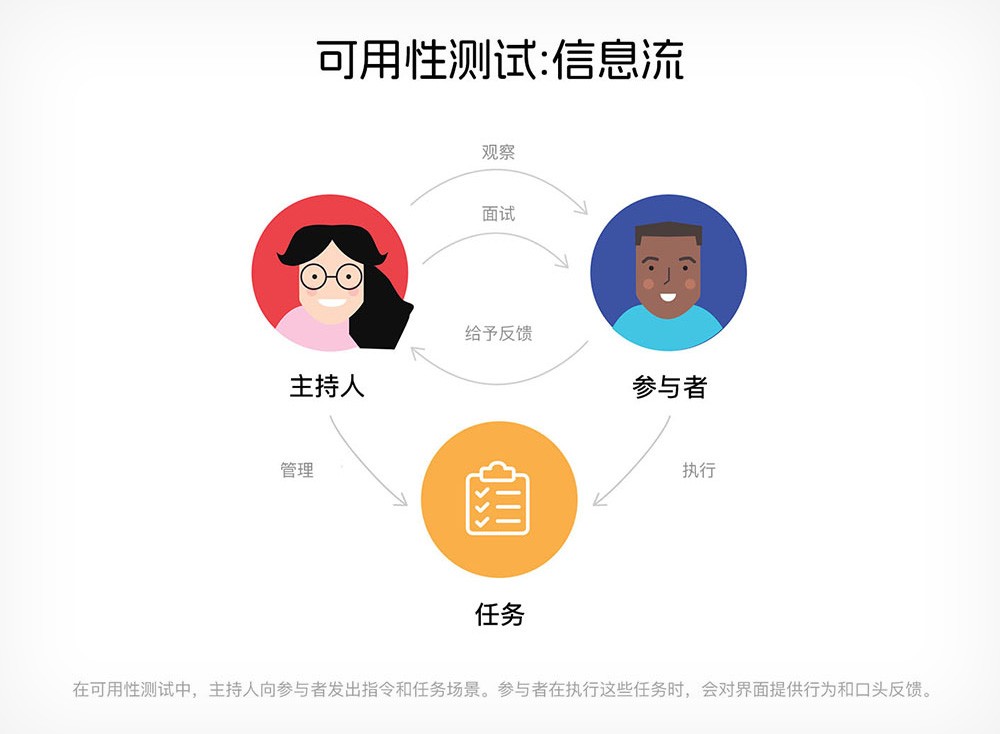
There are many forms of usability testing, but most include three core elements: a facilitator, tasks, and participants.

The facilitator assigns tasks to the participant. While the participant completes them, the facilitator observes behavior and listens to feedback. Follow-up questions may also be asked to understand the participant’s experience in greater detail.
The Facilitator
The facilitator guides the participant through the testing process, provides instructions, answers questions, and asks follow-up questions.
The facilitator must obtain high-quality, valid data without unintentionally influencing the participant’s behavior. Achieving this balance is difficult and requires training.
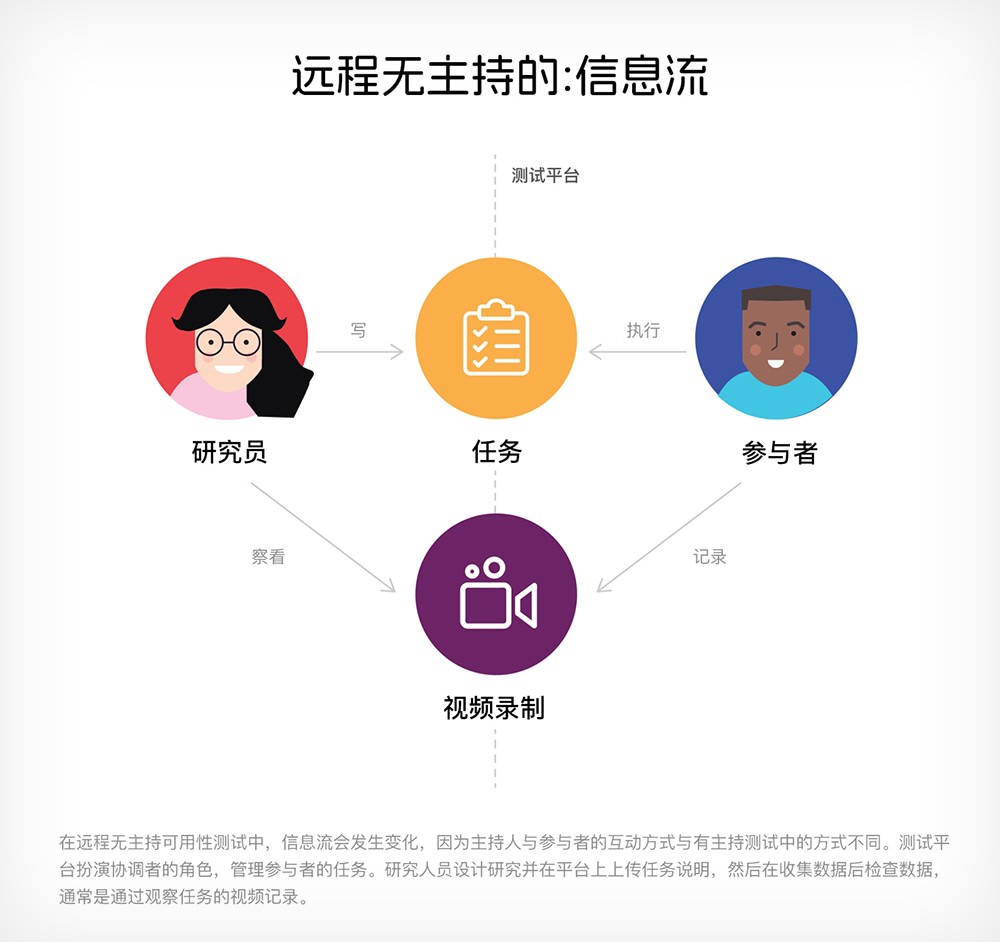
In remote unmoderated usability testing, an application can perform some of the facilitator’s functions.
Tasks
Tasks in a usability test represent real activities that participants might perform in everyday life. They may be highly specific or relatively open-ended, depending on the research question and the form of testing.
Examples of tasks in a real usability study include:
· Your printer displays “Error 5200.” How would you clear the error message?
· You are considering applying for a new credit card from China Construction Bank. Visit jsyh.com and decide which card you might choose, assuming you are already a customer.
· You have been told that you need to speak with Huang Bo in the project-management department. Use the intranet to find that person’s location, then tell the researcher your answer.
Task wording is extremely important in usability testing. Even small errors can cause participants to misunderstand what they are expected to do or can influence the way they complete the task.
Task instructions can be delivered verbally by the facilitator or written on a task sheet. Participants are often asked to read the instructions aloud. This helps ensure that they read the complete task and also supports accurate research notes because the researcher knows exactly which task the user is performing.
Participants
Participants should be real users of the product or service being studied. This may mean that they already use it in everyday life. In other cases, they may simply share the background or needs of the target user group, even if they are not yet users of the product.
During usability testing, the facilitator may ask participants to describe their actions and thoughts aloud while performing tasks. This think-aloud approach is intended to reveal behavior, goals, reasoning, and motivation.

Types of Usability Testing
Qualitative and Quantitative Testing
Usability testing can be either qualitative or quantitative.
· Qualitative usability testing focuses on gathering insight into how people use a product or service. It is most effective for discovering problems in the user experience and generally provides richer diagnostic insight than quantitative testing.
· Quantitative usability testing focuses on collecting metrics that describe the user experience. Two of the most common measures are task-success rate and time on task. Quantitative usability testing is particularly useful for establishing benchmarks.
The number of participants required depends on the type of study. For a typical qualitative study involving one user group, five participants are commonly recommended to identify most of the product’s frequent usability problems.
Remote and In-Person Testing
Remote usability tests are popular because they generally require less time and money than in-person studies. There are two types of remote usability testing: moderated and unmoderated.
· Remote moderated usability testing works much like an in-person study. The facilitator still interacts with the participant and asks them to complete tasks, but the two people are in different locations. Screen-sharing software is commonly used to conduct and moderate the session.
· Remote unmoderated usability testing differs from both in-person and remote moderated testing. The researcher uses an online testing tool to assign written tasks, and participants complete them independently at a time of their choosing. The tool provides task instructions and follow-up questions. After completion, the researcher receives the session record and indicators such as whether the tasks were completed.
The Cost of Usability Testing
A simple usability study can be inexpensive and may require little more than participant incentives. Sessions can be conducted in a meeting room, and a basic study can be completed in three days:
· Day 1: Develop the plan
· Day 2: Test with five users
· Day 3: Analyze the results and convert them into design recommendations for the next iteration
More expensive studies are sometimes necessary, and the most elaborate research programs can cost millions.
Factors that increase cost include:
· Testing multiple design alternatives
· Conducting international testing across multiple countries
· Testing with multiple user groups or personas
· Conducting quantitative research
· Using advanced equipment such as eye trackers
· Requiring a dedicated usability laboratory or focus-group room so additional observers can watch
· Producing detailed analysis and formal reporting of the findings.
This concludes our brief introduction to usability testing. We hope it is helpful. If you have new ideas, you are welcome to discuss them with 58UI Studio.