A few years ago, many teams used a simple standard for design delivery: draw the pages, make the components usable, and ensure developers can reproduce them. Today, products iterate faster, product lines multiply, and teams are more distributed. A page-by-page approach can no longer support long-term growth. Design systems have therefore moved from a useful enhancement to standard infrastructure.
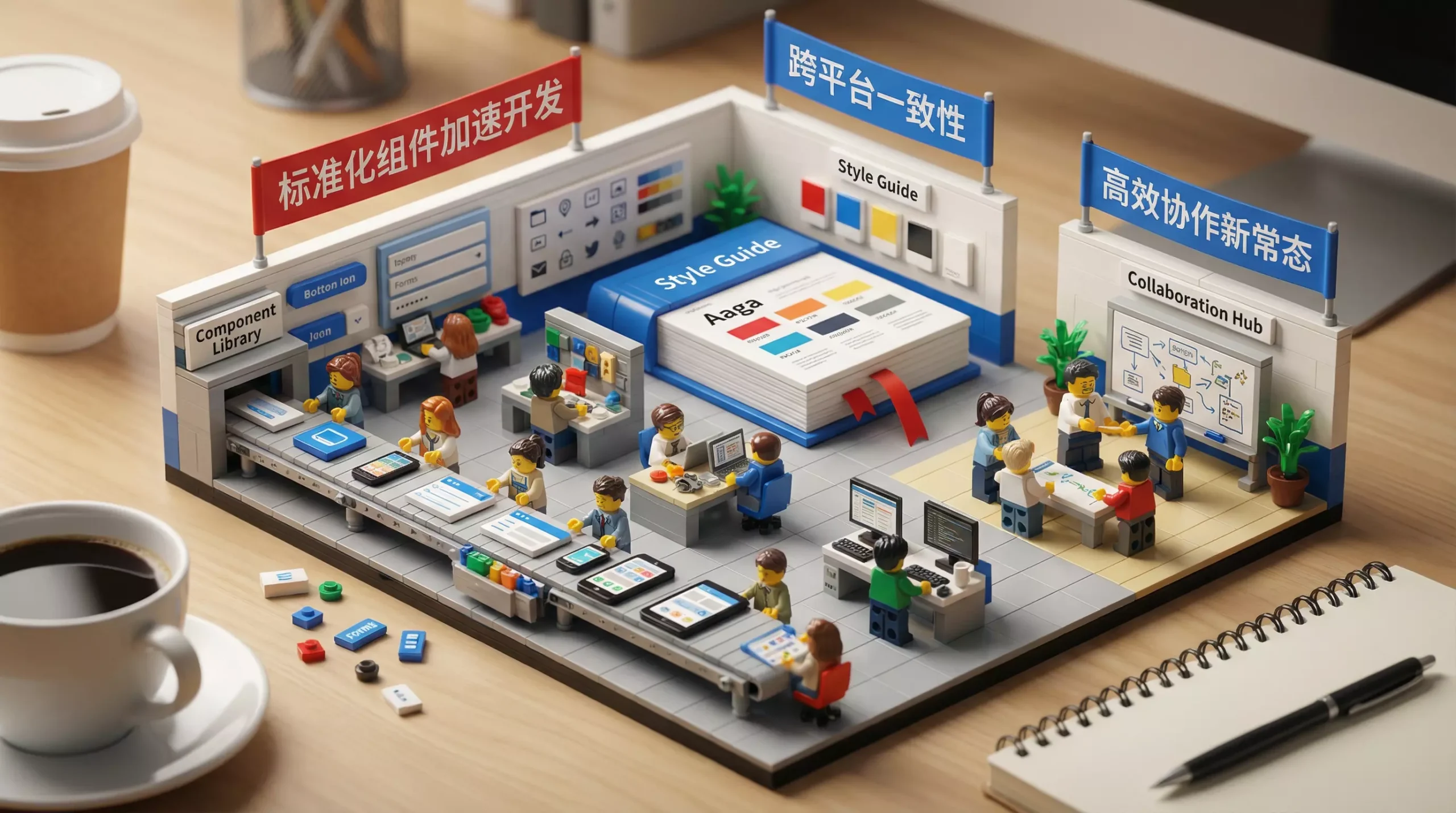
1. Design Systems Solve Consistency and Scale, Not Merely Appearance. A design system delivers three core forms of value: 1) Consistency: the same buttons, typography, and spacing rules appear across every page, reducing confusion and making the product feel more reliable. 2) Efficiency: new pages do not start from zero, because designers and developers can reuse components and deliver substantially faster. 3) Scalability: as product lines expand, the system maintains a unified style and supports rapid iteration instead of allowing each line to create its own visual language. In other words, a design system upgrades design capability from a handcrafted process to a production line.
2. A Design System Is Not a Component Library; It Is Standards + Assets + Process. Many teams think a design system is simply a Figma file or a repository of UI components. A mature system includes at least:
-
Visual language: colors, typography, shadows, icon styles, and illustration guidelines
-
Design tokens: abstract variables for colors, spacing, type sizes, corner radii, and other properties that keep design and development aligned
-
Component library: reusable buttons, forms, navigation, dialogs, tables, and other elements
-
Interaction standards: definitions for hover, focus, disabled, error, and loading states
-
Documentation and examples: when and how each component should be used, and what should be avoided
-
Workflow: how the system is updated, reviewed, released, and maintained. Without a workflow, a design system quickly becomes a historical artifact that no one dares to change.
3. Why Product Teams Depend on Design Systems: The Collaboration Chain Is Too Long. Modern product teams often include product managers, designers, frontend and backend developers, testers, and operations staff. Differences become amplified as information moves through the chain:
-
The design contains two button styles, and developers do not know which is correct
-
Operations changes a piece of copy and the entire layout collapses
-
A new feature is added, and copied-and-pasted styles contaminate the component system. The purpose of a design system is to encode the rules so that individual changes do not easily damage overall quality. It moves team discussions from “Is this style correct?” to “Why are we doing this, and does it comply with the system?”
4. The ROI of a Design System: Prove It Is Not Bureaucracy with Numbers. Design systems are often dismissed as designers indulging themselves, but their value can be quantified:
-
Less time spent aligning design and development through meetings, verification, and rework
-
Faster delivery of new pages
-
Fewer design defects, including missing states and inconsistent error messages
-
More stable user experience because greater consistency lowers cognitive effort. Once these metrics are visible, a design system is no longer a cosmetic exercise. It becomes real infrastructure that reduces cost and improves quality.
5. Where to Begin: Build It as an MVP. Many teams try to create every possible component at once and eventually abandon the effort. A better approach is: 1) Establish tokens first: colors, type sizes, spacing, corner radii, and shadows. 2) Prioritize critical components: buttons, inputs, forms, cards, navigation, and dialogs. 3) Add documentation as each component is created: usage, considerations, and variant examples. 4) Complete every state: hover, active, disabled, loading, error, and success. 5) Establish a release cadence, such as monthly or quarterly, with a clear changelog. The goal is not perfection, but a system that is usable, iterative, and sustainable.
6. Common Failure: The System Exists but Is Not Adopted. Typical failure modes include:
-
No owner: everyone can change it, so ultimately no one is accountable for quality
-
No review: components change casually and the system quickly breaks down
-
Missing documentation: designers understand it but developers do not; when knowledgeable people leave, the system disappears with them
-
No migration strategy: old pages are never rebuilt, so the system’s value remains invisible. The solution is governance: define who can submit changes, who approves them, how they are validated, how they are released, and how legacy pages are migrated.
7. Future Direction: Design Systems Become the Underlying OS of Product Experience. As AI, cross-platform delivery, no-code tools, and component-based development become more common, design systems will increasingly function as experience operating systems:
-
Designers will focus more on system design and rule definition
-
Developers will assemble interfaces rapidly through tokens and components
-
AI will generate first drafts using system rules instead of producing large volumes of stylistically inconsistent output. The ultimate objective is for users to experience one stable, familiar, and trustworthy product world.
Conclusion. Design systems are becoming standard because a product is no longer a collection of pages; it is a sustainable experience-engineering program. Only a systematic approach allows teams to collaborate efficiently, improve consistency, and iterate continuously. Treat the design system as infrastructure, and you can deliver stable quality to users throughout long-term competition.