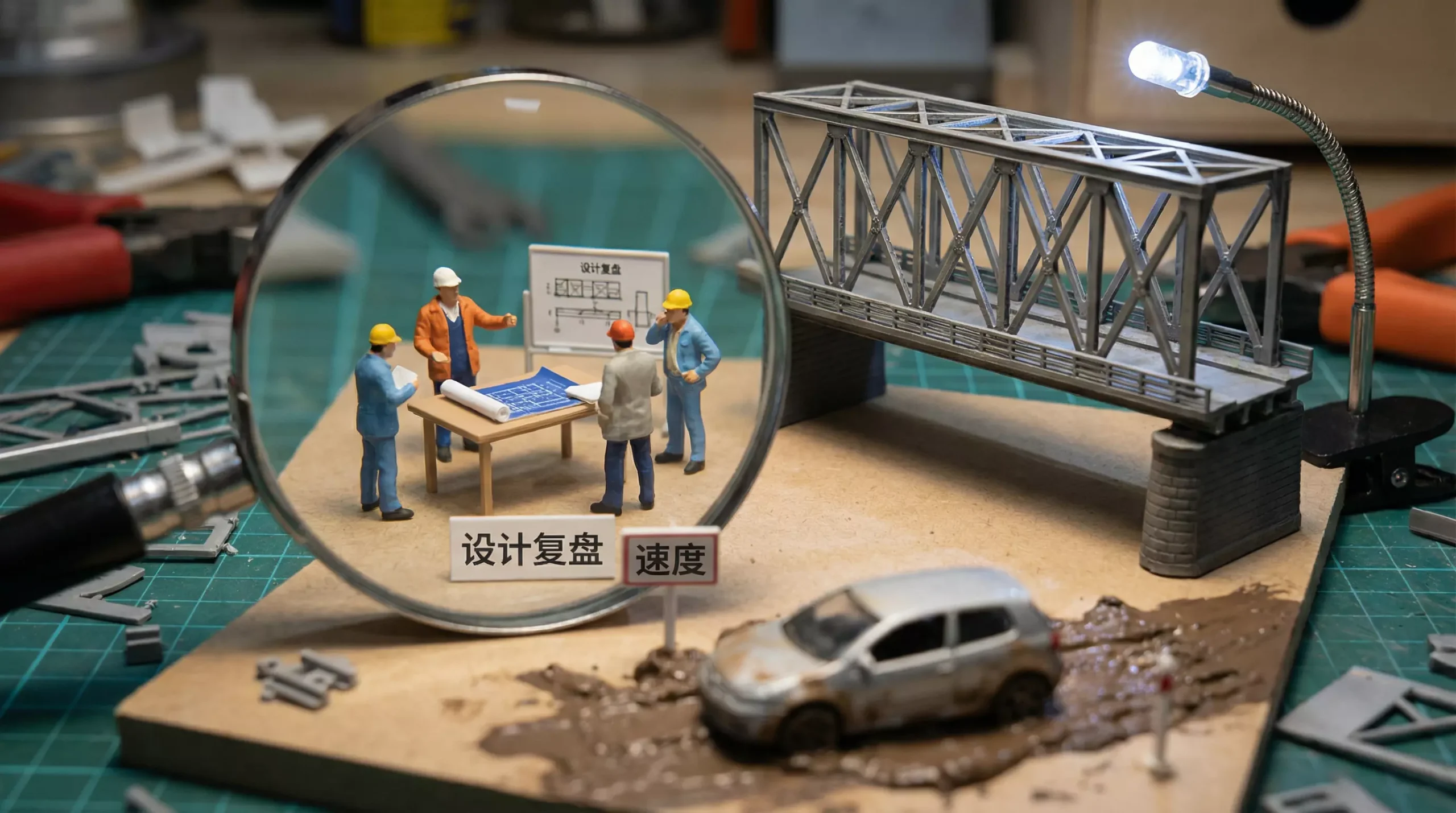
In most UI design companies and design teams, one phenomenon is extremely common: everyone is pursuing speed.
Requirements change today and must launch tomorrow. Project cycles continue to shrink, and schedules remain permanently tight. Over time, UI design becomes a high-frequency production process: complete the design, hand it to development, approve the launch. It appears efficient, but problems continue to accumulate.
Many design teams mistakenly believe that “speed is competitiveness.” In reality, without a retrospective mechanism, speed only amplifies errors. Successful decisions are never summarized, while failed decisions are not investigated. When a similar project arrives, the same problems occur again.
This is the real condition of many UI designers: 👉 Very busy, but not truly growing.
I. Why Do UI Design Companies Often Neglect Retrospectives?
In real projects, UI design companies frequently manage several projects simultaneously while facing tight client schedules and heavy delivery pressure. Retrospectives are therefore easily overlooked.
Common situations include:
-
The project is considered complete immediately after launch, with no subsequent review
-
Design reviews focus only on the result rather than the process
-
The team lacks shared design methods and standards
These problems produce one result: 👉 Design experience is not retained, and team capability cannot improve.
Over the long term, this affects not only UI design quality, but also the client experience and project stability.
II. The Core Value of Design Retrospectives: Turning Experience into Assets
The essence of a design retrospective is transforming one-time project experience into reusable team assets.
In a professional UI/UX design team, the retrospective is not “additional work.” It is part of the design process.
Its benefits include:
-
Improving the accuracy of design decisions
-
Establishing a shared design language and standards
-
Reducing repeated mistakes and improving overall efficiency
-
Improving team collaboration and reducing communication costs
For a UI design company, the ability to conduct retrospectives often determines whether the team has long-term competitiveness.
III. The Key to a Design Retrospective: Establish a Causal Chain of Decisions
Design without a retrospective remains at the level of the final result.
Design supported by a retrospective forms a clear logical chain:
👉 Why was it designed this way?
👉 What problem did this decision solve?
👉 Did it achieve the expected result?
Through the retrospective, designers should be able to explain:
-
Why the current component structure was selected
-
Why a particular interaction was used
-
Why the visual language matches the brand positioning
This is the “causal chain of design decisions.”
When UI designers develop this ability, design is no longer “making pages,” but “exercising judgment.”
IV. Four Core Questions for a High-Quality Design Retrospective
An effective retrospective does not require a complicated format, but it must answer four questions:
1. What Was the Result?
Did the project achieve its objective? Did the user experience improve?
2. What Happened During the Process?
Which key decisions influenced the final result?
3. Why Did It Happen?
What was the root cause of the problem: requirements comprehension, design judgment, or the process itself?
4. What Should Happen Next?
What needs adjustment? Who is responsible? How will the effect be validated?
When a retrospective is organized around these four questions, it becomes fact-based analysis rather than subjective discussion.
V. The Greatest Challenge of a Retrospective Is Not the Method, but the Mindset
Many UI design companies do not lack retrospective methods. They lack the awareness and willingness to use them.
People instinctively attribute problems to external causes:
-
Insufficient time
-
Changing requirements
-
Development problems
An effective retrospective returns attention to what the team can control:
👉 Was validation performed at critical stages?
👉 Were clear design standards established?
👉 Were risks identified in advance?
A retrospective becomes meaningful only when the team is willing to confront these questions.
VI. The Right Retrospective Culture: Find Problems in the System, Not a Person to Blame
A retrospective is not an exercise in criticizing individuals. It is a way to improve the system.
In a UI/UX design team, most problems do not arise from individual ability, but from systemic weaknesses such as:
-
An unclear design process
-
Incomplete information transfer
-
Missing design standards
-
Inconsistent acceptance criteria
If these problems remain unresolved, faster design simply repeats mistakes more quickly.
Conclusion
Speed is important in the UI design industry, but it should not be the only metric.
The team’s ability to improve continuously is what truly determines design quality.
The purpose of a retrospective is not merely to summarize the past, but to optimize the future.
When a UI design company begins taking retrospectives seriously, it no longer merely “delivers designs.”
It builds a stable, reusable, and continuously evolving design system.
That is the real source of long-term competitiveness.